Martyrs of Tokwon · 11 / 38
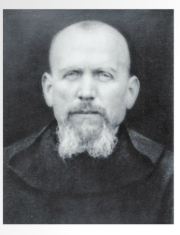
Baptismal name: Josef · First vows: July 11, 1909 · Sent to Korea: January 17, 1911
Duties: farm of the Paekdong monastery; building works of Tokwon Abbey
Arrested: May 11, 1949, at Tokwon Abbey · Died a martyr: July 3, 1949, Oksadok camp
Brother Petrus Gernert (1882–1949) was born on February 14, 1882, in Kleinwenkheim in the Diocese of Würzburg, Germany, to Josef Gernert and Margarita Schmit. He had no formal trade training and lacked the physical constitution for military service; it was only after entering the monastery that his gifts began to show. He entered St. Ludwig’s monastery (the forerunner of Münsterschwarzach Abbey) on Easter Sunday, March 31, 1907. Construction of the monastery and its church began just as he arrived, so his formation years passed amid upheaval — yet the building site became his school, where he learned every skill the work required. By his first profession on July 11, 1909, the construction was ending, and he was put in charge of the monastery garden while also helping with the farm and pasture. What later made Brother Petrus a seasoned builder and farm manager was no formal schooling but years of daily practice in the field.
On January 7, 1911, at St. Ottilien, a mission-sending ceremony was held for Brother Petrus and four other missionaries bound for Seoul. They set out on the long journey from which they would not return, in the company of Abbot Norbert Weber (1876–1956), who was planning a visitation of the newly founded Paekdong monastery in Seoul, and Prior Placidus Vogel (1871–1943). There was no time to adjust to the new world, none to learn the language. The Paekdong Chronicle records that by the spring of 1912 he had already planted three hundred fruit trees in the monastery garden and was raising two thousand saplings. After 1920, when the Seoul monastery was entrusted with the newly erected Vicariate of Wonsan, his talents came fully into play: directing his fellow brothers, he repaired the old parish buildings of Wonsan and Naepyong, enlarged the Haesong school in Wonsan, and built a new school at Munpyong — all while shuttling to Seoul to keep up the monastery farm.
In 1925 Brother Petrus supervised the construction of the bishop’s residence at the Wonsan parish and of the convent that would house the Missionary Benedictine Sisters of Tutzing soon to be sent to Korea. Then came the great task of his life: supervising the construction of Tokwon Abbey, designed by the architect Fr. Cajetanus Vierhaus (河, 1868–1936). He drove the work forward, moving tirelessly between building site and quarry. The Tokwon Chronicle calls him the indefatigable farm manager and building expert — though a boulder loosed in blasting once fell on his right foot and forced a long rest. He had no respite until the abbey church was completed in 1931. When all the building at the abbey, seminary included, was finished, he withdrew again to the farm and began to plant forest: from 1933 onward, five thousand roadside and ornamental trees and thirty thousand pines, larches, and boxwoods of his planting grew around the abbey. With the church complete, calls for Brother Petrus’s help poured in from the mission stations: with the other craftsman brothers he built the Yongheung parish church, and at the Kowon building site he survived a fall from the scaffolding. From the mid-1930s he sought a younger brother to take over the building work, trained Brother Anselm Schmit (1912–1949), sent from Münsterschwarzach, and retired to the farm.
In 1940, when Bishop-Abbot Bonifatius Sauer (辛上院, 1877–1950) took over the Beuron monastery’s foundation at Tonogaoka in Japan (near Chigasaki, Kanagawa), he sent Brother Petrus there to manage the woods and farm and help in the kitchen. Prior Lucius Roth wrote to the mission procure on January 31, 1944, that Petrus had returned from Japan and was again walking the whole abbey, fretting over this and that: “The first-generation brothers — Markus Metzger, Petrus Gernert, Eugen Ostermeier, Januarius Schroetter, Paschalis Fangauer, Gottlieb Auer — are now ‘truly old professionals,’ but they still work as hard as their strength allows.”
After the North Korean regime closed Tokwon Abbey on May 11, 1949, Brother Petrus was imprisoned with his brothers in the Pyongyang prison and transferred on August 5 to the Oksadok camp in Chonchon county, Chagang Province. Already so weakened that he had to be carried, he became the camp’s first victim. Sister Diomedes Meffert (1909–1998), who nursed the sick at Oksadok, testified to his end: “I never met Brother Petrus Gernert myself. The brothers told me that already in prison he had suffered severe dysentery, and that he would sit quietly in a corner, sunk in thought, praying without ceasing. The hard climb up to the camp — there was no way but for the brothers to carry him on their backs by turns — drained what strength he had. … He lay in the room, quietly praying, most of the time. And in the night of July 2 he died so quietly that even the man lying beside him did not notice. He was the first to be buried on the stony mountainside above the camp. When I first stood before his grave, I wondered with dread how many would come to lie beside him.”
한국어 원문
세례명: 요셉 · 첫서원: 1909년 7월 11일 · 한국 파견: 1911년 1월 17일
소임: 백동 수도원 농장 및 덕원 수도원 건축 담당
체포: 1949년 5월 11일, 덕원 수도원 · 순교: 1949년 7월 3일, 옥사덕 수용소
베드로 게르네르트 수사(Gernert Petrus, 1882~1949)는 1882년 2월 14일 독일 뷔르츠부르크Würzburg 교구 클라인벤크하임Kleinwenkheim에서 아버지 요셉 게르네르트Josef Gernert와 어머니 마르가리타 쉬미트Margarita Schmit 슬하에서 태어났다. 전문적인 직업교육을 받은 적이 없고, 군 생활을 해낼 만한 신체적 조건을 갖추지 못한 그는 수도원에 들어온 뒤에야 두각을 보이기 시작했다. 그는 1907년 3월 31일 부활대축일에 상트 루드비히St. Ludwig 수도원(뮌스터슈바르작Münsterschwarzach 수도원의 전신)에 입회했다. 그가 입회하자마자 수도원과 성당 건축공사가 시작되어 매우 혼란스러운 분위기에서 양성기를 보냈다. 한편 건축공사에 필요한 모든 기술을 현장에서 습득할 수 있는 좋은 기회가 되었다. 1909년 7월 11일 첫서원을 할 무렵, 공사가 마무리 되어 그는 수도원 정원 일을 맡아 보면서 농장과 목장 일도 거들어야 했다. 훗날 베드로 수사를 노련한 건축 기술자와 농장 관리인으로 만든 것은 이런저런 전문교육이 아니고 다년간의 일상적인 현장 실습이었다.
1911년 1월 7일 상트 오틸리엔 수도원에서 베드로 수사를 비롯하여 서울로 파견되는 5명의 선교사들의 파견식이 거행되었다. 그들은 갓 설립된 서울 백동 수도원 시찰차 한국 방문을 계획한 노르베르트 베버 아빠스(Norbert Weber, 1876~1956)와 플라치도 포겔(Placidus Vogel, 1871~1943) 원장신부와 함께 다시 돌아오지 못할 머나먼 여행길에 올랐다. 새로운 환경에 적응할 시간도 한국말을 배울 시간도 없었다. 『백동 연대기』는 그가 1912년 봄에 이미 수도원 정원에 과실나무 300그루를 심고 과실수 묘목 2천 그루를 재배하고 있었다는 사실을 알려준다. 1920년 서울 수도원이 새로 설정된 원산 대목구의 사목활동을 위임받은 후 그의 재능이 십분 발휘되기 시작했다. 그는 동료 수사들을 지휘하여 원산과 내평의 낡은 본당 건물을 수리하였으며 원산 해성학교를 증축하고 문평에도 새 학교를 지었다. 바쁜 와중에도 서울을 오가며 수도원 농장관리에도 여념이 없었다.
1925년 베드로 수사는 원산 본당에 주교관과 장차 한국으로 파견될 툿찡 포교 베네딕도회 수녀들이 거주할 수녀원 건물의 건축공사를 감독했다. 그런 다음 자신의 최대 과업으로, 전문 건축 기사 카예타노 피어하우스(Cajetanus Vierhaus, 河, 1868~1936) 신부가 설계한 덕원 수도원의 건축공사를 감독했다. 그는 공사장과 채석장을 부지런히 오고가며 공사를 진행시켰다. 『덕원 연대기』에서 지칠 줄 모르는 농장 관리자이자 건축 전문가로 지칭되던 그는 폭파 작업 중 바윗덩어리가 오른발에 떨어져 꽤 오랫동안 일을 쉬기도 했다. 그는 1931년 수도원 성당이 완공될 때까지 쉴 틈이 없었다. 신학교를 비롯한 수도원의 모든 공사가 마무리되자 그는 다시 농장으로 물러나 숲을 조성하기 시작했다. 수도원 주위에는 1933년부터 그가 심은 가로수와 관상수 5천 그루와 소나무, 낙엽송, 회양목 3만 그루가 자라고 있었다. 수도원 성당이 완공되자 선교 현장에서 베드로 수사의 도움을 요청하는 목소리가 쇄도했다. 그는 다른 기능공 수사들과 함께 영흥 본당을 지었고, 고원 본당 건축 현장에서는 비계에서 떨어지는 사고까지 당했다. 1930년대 중반부터 그는 건축 일을 넘겨받을 젊은 형제를 물색했다. 그리하여 뮌스터슈바르작 수도원에서 파견된 안셀모 슈미트(Anselm Schmit, 1912~1949) 수사에게 일을 가르쳐주고 농장으로 물러났다.
1940년, 일본 도노가오카稻ケ丘(가나가와현 지가사키정 소재)에 있는 보이론 수도원의 분원을 인수받은 보니파시오 사우어(Bonifatius Sauer, 辛上院, 1877~1950) 주교 아빠스는 베드로 수사를 그곳에 파견하여 숲과 농장을 관리하고 주방 일을 보게 했다. 루치오 로트 원장 신부는 우츠나 수도원 선교총무국에 보낸 1944년 1월 31일자 편지에 그가 일본에서 돌아왔는데 여전히 이런저런 걱정을 하며 수도원을 두루 살펴보고 다닌다고 썼다. “마르코 메츠거, 베드로 게르네르트, 에우제니오 오스터마이어, 야누아리오 슈뢰터, 파스칼 팡가우어, 고밀리로 아우어 등 첫 세대 수사들은 이제는 ‘정말로 늙은 전문가들’이지만 여전히 힘닿는 대로 열심히 일합니다.”
1949년 5월 11일, 북한 공산정권이 덕원 수도원을 폐쇄한 후 베드로 수사는 수도형제들과 평양 인민교화소에 수감되었다가, 8월 5일 자강도 전천군에 위치한 옥사덕 수용소로 이송되었다. 그는 업혀 다녀야 할 만큼 이미 쇠약해져 있었고 옥사덕 수용소의 첫 희생양이 되었다. 옥사덕 수용소에서 환자를 돌보았던 디오메데스 메퍼트 수녀(Diomedes Meffert, 1909~1998)는 그의 최후를 이렇게 증언했다. “페트루스 게르네르트 수사를 직접 만나지는 못했다. 수사들이 나에게, 그는 이미 감옥에서 설사를 심하게 했고 구석에 조용히 앉아 깊은 생각에 잠기어 계속해서 기도를 했다고 이야기 했다. 수사들이 그를 간간이 업고 가는 것 이외에는 별다른 방법이 없었던, 수용소로 올라가는 어려운 길이 그를 매우 쇠약하게 했다. … 그는 대부분 조용히 기도하면서 방안에 누워 있었다. 그리고 7월 2일 밤, 그는 바로 옆에 누워있던 사람도 알아채지 못할 정도로 조용히 사망했다. 그는 수용소 위에 있는 돌투성이의 산허리에 묻힌 최초의 사람이었다. 내가 처음으로 그 앞에 섰을 때 나는 두려운 마음으로 앞으로 얼마나 많은 사람이 그 옆에 눕게 될 것인지를 생각했다.”
Source: the “Martyrs of Tokwon” series from BUNDO, the quarterly of Waegwan Abbey, reprinted and translated here with permission.
출처: 성 베네딕도회 왜관수도원 계간지 《분도》 ‘시복시성 대상자 약전’ 연재 · 왜관수도원의 허락을 받아 게재·번역합니다.
Leave a Reply