Martyrs of Tokwon · 16 / 38
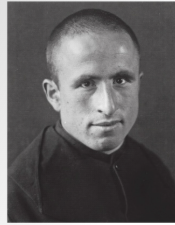
Baptismal name: Rudolf · First vows: May 13, 1933 · Sent to Korea: October 11, 1936
Duty: painting and building work
Arrested: May 11, 1949, at Tokwon Abbey · Died a martyr: December 13, 1950, Manpo-Kwanmunri camp
Brother Solanus Hermann (1909–1950) was born on May 19, 1909, at Thal near Illerberg in the Diocese of Augsburg, Germany. His father was the metalworker Pius Hermann; with his mother Maria Linder there were, besides himself, four sons in the family. Baptized Rudolf, he grew up receiving a sound formation in the faith at home and at school. The handwritten curriculum vitae he submitted to St. Ottilien on February 10, 1931, sums up his youth: “From June 25, 1923, I apprenticed with Mr. Haberes, master painter in Weissenhorn. After completing my apprenticeship I passed the journeyman’s examination on September 17, 1926, and worked as Mr. Haberes’s assistant until November 1927. Since May 1928 I have been with Mr. Wilhelm Geissler, master painter. I now give up my trade to choose the monastic vocation.”
Entering St. Ottilien, Brother Solanus began his novitiate on May 12, 1932, with twenty-three companions. He made his first profession on May 13 of the following year and his perpetual vows on June 7, 1936. He had always dreamed of the African missions, but on October 11, 1936, he was sent to Korea. Under the banner hung at the St. Ottilien railway station — “Farewell! Bearers of German culture to far-off Korea” — he parted from a homeland he would never see again. At Tokwon he began learning Korean from the shoemaker Brother Ludwig Fischer (裵, 1902–1950). The German brothers of Tokwon, the familiar Latin liturgy, and work suited to his craft gave him steadiness. The abbey’s buildings had been raised in great haste, so there was always work for a master painter. A postcard he sent on March 21, 1941, to Fr. Hugo Reinhart (1884–1969) at St. Ottilien betrays his troubles: “From the mission there is little to report, Father. To accomplish anything now is very difficult. Good materials are scarce and wages have risen three or four times over three years ago. That I am healthy and have work every day — I could ask for nothing more.”
A letter that Brother Ägidius Eichhorn (方, 1905–1995), later farm manager of Tokwon Abbey, sent to Brother Solanus’s family describes his monastic life: “Brother Solanus was a brother always kind to everyone and eager to help — he helped me especially much. In wartime there was no building work in the mission, so the painters had many idle hours. Brother Solanus spent several hours a day working on the farm. He loved farm work — above all the tending of fruit trees, and the trees he tended bore well. Those were still peaceful times.”
That brief peace was shattered. After liberation the Soviet Red Army occupied the North and communist power grew. When the regime was established on September 9, 1948, people sensed that Tokwon Abbey’s end was near. On the nights of May 8 and 10, 1949, the political security police descended on the abbey and arrested all the German missionaries and the Korean priests; on the 14th they dispersed the remaining Korean brothers and the seminarians and closed the abbey. Brother Solanus was arrested with his companions, held in the Pyongyang prison, and transferred on August 5 to the Oksadok camp in Chonchon county, Chagang Province. Short of stature but sturdy and strong of bearing, he took on the hardest labor in the camp — charcoal burning. Each evening, returning exhausted, he went first to the chapel. His ragged clothing and his soot-blackened face, bearing a deep and quiet serenity, became for the survivors the enduring image of Oksadok.
When the North Korean army, checked by the allied counteroffensive, fell back to the Yalu in 1950, he and his companions endured the so-called ‘death march.’ It reached Manpo on October 25, crossed the Yalu to halt at Chi-an on October 27, and, as the Chinese army entered the war, crossed back again to Manpo. The days in the Manpo-Kwanmunri camp were an encounter with utter despair. Fr. Canut d’Avernas (羅國宰, 1884–1950) died on November 6, 1950; Fr. Gregor Sorger (金, 1906–1950) on November 15; Brother Hilarius Hoiss (許喜樂, 1888–1950) on December 12; and on the following day Brother Solanus Hermann. Sister Diomedes Meffert (1909–1998), the camp’s physician, tells of his end:
“Brother Solanus lay in a corner of the dugout, nearly unconscious. Then, driven by hunger, he volunteered to work in the kitchen, where something edible might still be found. But in the kitchen he seems to have eaten something harmful. It inflamed his intestines severely, and his weakened heart could not bear it. Early on December 13 I woke to the sound of his labored, rattling breath and hurried to him — he was already unconscious, and barely received the anointing of the sick. Brother Solanus’s death was a terrible shock to us, for only the day before we had laid Brother Hilarius Hoiss in the earth. His death showed us starkly how hopeless our situation then was.”
한국어 원문
세례명: 루돌프 · 첫서원: 1933년 5월 13일 · 한국 파견: 1936년 10월 11일
소임: 건축 담당
체포: 1949년 5월 11일, 덕원 수도원 · 순교: 1950년 12월 13일, 만포 관문리 수용소
솔라노 헤르만(Solanus Hermann, 1909~1950) 수사는 1909년 5월 19일 독일 아우크스부르크Augsburg 교구 일러베르크Illerberg 부근 탈Thal에서 태어났다. 아버지는 철공 기술자 피우스 헤르만Pius Hermann과 어머니 마리아 린더Maria Linder 슬하에는 그를 제외하고 네 명의 아들이 있었다. 루돌프Rudolf라는 이름으로 세례를 받은 그는 가정과 학교에서 충실한 신앙교육을 받으면서 자라났다. 1931년 2월 10일에 작성되어 상트 오틸리엔St. Ottilien 수도원에 제출한 자필 이력서에는 그의 청소년 시절이 간략히 요약되어 있다. “1923년 6월 25일부터 비이센호른Wiessenhorn의 도장塗裝 장인 하베레스Haberes 씨에게서 도제 수습을 시작했습니다. 도제 수습을 마치고 1926년 9월 17일 기능사 시험을 통과한 후, 1927년 11월까지 하베레스 씨의 조수로 일했습니다. 1928년 5월부터 지금까지는 도장 장인 빌헬름 가이슬러Wilhem Geissler 씨 댁에 있습니다. 이제 저는 수도소명을 선택하기 위해 저의 직업을 포기합니다.”
상트 오틸리엔 수도원에 입회한 솔라노 헤르만 수사는 1932년 5월 12일 동료 스물세 명과 함께 수련기를 시작했다. 그는 이듬해 5월 13일 첫서원을 했고 1936년 6월 7일 종신서원을 발했다. 그는 평소 아프리카 선교를 꿈꾸었으나 1936년 10월 11일에 한국으로 선교 파견되었다. 그는 상트 오틸리엔 기차역에 걸린 ‘환송! 머나먼 한국 땅의 독일 문화 전달자들’이라는 현수막을 보며 다시는 돌아오지 못할 고국과 이별했다. 덕원 수도원에 도착한 그는 제화공 루도비코 피셔(Ludwig Fischer, 裵, 1902~1950) 수사에게 한국말을 배우기 시작했다. 덕원 수도원의 독일인 수도형제들과 익숙한 라틴어 전례 그리고 적합한 소임은 그에게 안정감을 주었다. 덕원 수도원의 건물들은 아주 조급하게 지어졌기 때문에 도장 장인이 해야 할 일은 늘 많았다. 1941년 3월 21일 그가 상트 오틸리엔 수도원의 후고 라인하르트(Hugo Reinhart, 1884~1969) 신부에게 보낸 엽서에 그의 고충이 엿보인다. “선교지역 일은 신부님께 보고할 것이 별로 없습니다. 지금 무엇을 이루어 낸다는 것은 매우 어렵습니다. 좋은 자재도 부족하고 노임도 3년 전에 비해 서너 배 올랐습니다. 그저 제가 건강하고 날마다 할 일이 있으니 더 바랄 게 없습니다.”
후일 덕원 수도원의 농장 관리인 에지디오 아이히호른(Ägidius Eichhorn, 方, 1905~1995) 수사가 솔라노 헤르만 수사의 가족에게 보낸 편지에는 그의 수도생활이 이렇게 적혀 있다. “솔라노 수사는 모두에게 늘 친절하고 남을 도와주려고 애쓴 형제였습니다. 특히 저를 많이 도와주었습니다. 전시에는 선교 지역에서 건축 공사를 못했기 때문에 도장공들은 한가한 시간이 많았습니다. 그동안 솔라노 수사는 하루에도 몇 시간씩 농장에서 일했습니다. 그는 농장 일을 아주 좋아했습니다. 특히 과실수 가꾸는 일을 좋아했습니다. 그가 가꾼 과실수들은 작황이 좋았습니다. 그때는 그래도 평온한 시간이었습니다.”
잠시 누렸던 평온의 시기는 깨졌다. 해방 이후 북한에 소련의 붉은 군대가 진주하고 공산주의 세력이 득세했다. 1948년 9월 9일 북한에 공산 정권이 수립되자 사람들은 덕원 수도원의 최후가 가까워졌음을 예감했다. 1949년 5월 8일과 10일 두 차례에 걸쳐, 야음을 틈타 수도원에 들이닥친 정치보위부원들은 독일인 선교사 전원과 한국인 사제들을 체포했고, 같은 달 14일에는 나머지 한국 수사들과 덕원 신학교의 신학생들을 해산하고 수도원을 폐쇄했다. 솔라노 헤르만 수사도 동료들과 함께 체포되어 평양 인민교화소에 구금되었다가 8월 5일 자강도 전천군에 위치한 옥사덕 수용소로 이송되었다. 작달막한 체구였지만 튼튼하고 강인한 인상을 가졌던 그는 수용소에서도 숯 굽는 일같이 가장 힘든 작업을 맡았다. 매일 저녁 지친 몸으로 돌아온 그는 제일 먼저 경당으로 향했다. 그의 남루한 옷차림과 깊고 고요한 평정을 간직한 검댕투성이 얼굴은 옥사덕 수용소의 상징으로 후일 생존자들에게 기억에 오랫동안 남았다.
1950년 전쟁을 일으켜 초반에 승기를 잡던 북한 인민군은 연합군의 공세에 밀려 압록강까지 후퇴하자, 그와 동료들은 이른바 ‘죽음의 행진’을 겪었다. 죽음의 행진은 10월 25일 만포에 이르렀다가 압록강을 건너 10월 27일 집안集安에 멈추었고 중국 인민해방군이 전쟁에 개입함에 따라 다시 압록강을 건너 만포로 이어졌다. 만포 관문리 수용소에서 보낸 시간은 극한의 절망과 맞닥뜨린 순간이었다. 1950년 11월 6일 카누토 다베르나스(Canut d’Avernas, 羅國宰, 1884~1950) 신부, 11월 15일 그레고리오 조르거(Gregor Sorger, 金, 1906~1950) 신부, 12월 12일 힐라리오 호이스 수사(Hilarius Hoiß, 許喜樂, 1888~1950), 그리고 이튿날 솔라노 헤르만 수사가 선종했다. 당시 의사였던 디오메데스 메퍼트(Diomedes Mefert, 1909~1998) 수녀는 그의 최후를 이렇게 전한다.
“솔라노 수사님은 방공호 구석 자리에 거의 의식을 잃은 상태로 누워 있었습니다. 그러다가 너무 배가 고픈 나머지 그나마 먹을 만한 것을 좀 구할 수 있는 부엌에서 일을 하겠다고 자원했습니다. 그런데 부엌에서 무언가 해로운 것을 먹은 것 같습니다. 이것이 장 점막에 심한 염증을 일으켰고 약한 심장이 그것을 감당하지 못했습니다. 12월 13일 이른 아침에 수사님이 그르렁거리며 가쁜 숨을 몰아쉬는 소리에 잠에서 깨어 급히 가 보니, 이미 의식이 없고 병자 성사만 겨우 받았습니다. 솔라노 수사님의 죽음은 우리에게 무서운 충격이었습니다. 바로 전날 힐라리오 호이스 수사님을 땅에 묻었기 때문입니다. 솔라노 수사님의 죽음은 당시 아무런 희망이 없던 우리 처지를 단적으로 보여준 셈이었습니다.”
Source: the “Martyrs of Tokwon” series from BUNDO, the quarterly of Waegwan Abbey, reprinted and translated here with permission.
출처: 성 베네딕도회 왜관수도원 계간지 《분도》 ‘시복시성 대상자 약전’ 연재 · 왜관수도원의 허락을 받아 게재·번역합니다.
Leave a Reply