Martyrs of Tokwon · 26 / 38
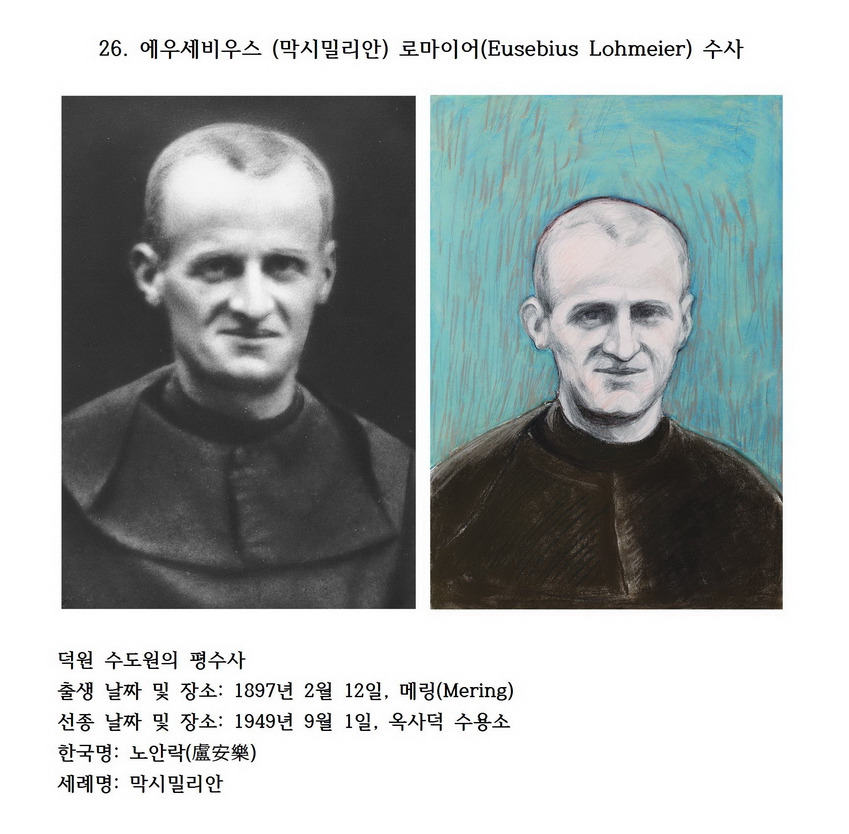
Brother Eusebius (Maximilian) Lohmeier was born on February 12, 1897, at Mering in Swabia, to Max Lohmeier and Kreszenz Scheffler. He entered the monastery in May 1914, but was conscripted in 1916 and served in the war in France until 1918.
He began his novitiate on March 21, 1919, with the religious name Eusebius, made his first profession on April 5, 1920, and his perpetual vows on April 5, 1923. On March 30, 1924, he was sent briefly to San Beda in Dinalupihan in the Philippines, and on September 3, 1924, to Korea, where he directed the carpentry in the building of the Tokwon and Yenki monasteries and of the cathedral in Pyongyang. In May 1949 he was imprisoned in Pyongyang, then transferred to the Oksadok labor camp, where he died of malnutrition on September 1 [1952].
Testimony of Sister Diomedes Meffert, physician in the camp: “Brother Eusebius Lohmeier was a carpenter of gigantic build, and before hunger weakened him in the camp he liked to boast of how heavy a tree trunk he could carry. In the first year of camp life he suffered, like so many, from severe festering skin abscesses brought on by vermin and filth. At Manpo he was badly frostbitten: the skin peeled from nearly all his toes, and on two of them the joints lay bare. After the return from Manpo he built sheep pens and stables; in that time his health was fair and he seemed to adapt comparatively well (of hunger he did not speak much). But then he was put to field work in the fiercest heat, in the hardest weeks of weeding, and it wore him down utterly. He often complained of dizziness and back pain but understood little of his own symptoms. He was among those least troubled by dysentery — yet in mid-August he contracted an acute intestinal catarrh that ran a course like cholera. With a proper diet and tonics he might have been saved; we had none. His already wasted body could no longer withstand the acute attack. I myself had to work in the fields in those days, and when I was suddenly called back to the camp about eleven o’clock on September 1, he already lay unconscious in the sickroom. He had collapsed on the way to the latrine set apart from the house, and his companions had carried him to the room for the gravely ill. We all loved him. His calm, his composure that nothing could shake, often cheered us amid the torments of camp life.”
한국어 원문
막시밀리안(에우세비우스 수사) 로마이어는 1897년 2월 12일 메링(슈바벤)에서 부친 막스 로마이어와 모친 크레스첸츠 쉐플러 사이에 태어났다. 막시밀리안은 1914년 5월 수도원에 입회하였으나 1916년 군대에 징집되어 1918년까지 프랑스에서 전쟁에 참전했다. 1919년 3월 21일 에우세비우스(Eusebius)라는 수도명을 받고 수련기를 시작한 그는1920년 4월 5일 첫 서원을 하였고 1923년 4월 5일 종신서원을 하였다. 에우세비우스 수사는 1924년 3월 30일 필리핀 디날루피한의 성 베니토에 잠시 파견되었다가 1924년 9월 3일에 한국으로 파견되었는데, 한국에서 덕원과 연길 수도원 건축 그리고 평양 주교좌성당 건축에서 목수 일을 지휘하였다. 그는 1949년 5월 평양 감옥에 수감되었다가 옥사덕 강제 수용소로 이송되었고 그곳에서 9월 1일 영양실조로 사망하였다.
강제 수용소의 수녀 의사 디오메데스 메퍼트의 증언
에우세비우스 로마이어 수사는 거인 같은 체구의 목수였고, 수용소에서의 굶주림으로 약해지기 전에는 얼마나 무거운 나무 밑둥을 옮길 수 있는지 종종 자랑하곤 했다. 수용소 생활 첫 해에 그는 다른 많은 사람들처럼 해충과 불결함으로 인한 화농성 피부농종을 심하게 앓았다. 만포 시절에 그는 심하게 동상에 걸려서 거의 모든 발가락의 피부가 벗겨지고 두 개 발가락에서는 관절 마디가 드러났다. 만포에서 돌아온 이후에 그는 양 우리와 마구간 짓는 일을 했는데, 이때는 비교적 건강이 좋았으며 비교적 환경에 적응을 잘하는 것처럼 보였다(굶주림에 관해서 그는 말을 많이 하지 않았다.). 그러나 그 후 그는 혹심한 더위와 가장 어려운 잡초 뽑는 기간에 농사일을 하게 되었으며, 이 일이 그를 매우 지치게 했다. 그는 자주 현기증과 등의 통증을 호소했으나 자기 병의 증세에 대한 이해가 별로 없었다. 그는 가장 적게 설사를 앓았던 사람들 중 하나였다. 그러나 8월 중순 그는 콜레라와 비슷하게 진행된 급성 장 카타르에 걸리게 되었다. 적당한 식이요법과 강장제가 있었다면 그를 구할 수도 있었을 것이다. 그러나 우리에게는 그런 것이 없었다. 이미 아주 수척해진 육체는 급성적인 발병을 더 이상 감당해내지 못했다. 나 자신도 그 시기에는 들에서 일을 해야 했는데, 내가 9월 1일 11시경에 갑자기 수용소로 불려왔을 때 그는 이미 의식을 잃은 채 병실에 누워 있었다. 그는 집에서 약간 떨어진 화장실로 가는 도중에 쓰러졌으며, 그의 동료들이 그를 중환자용 방으로 데려다놓았던 것이다. 우리 모두는 그를 좋아했다. 그의 평온하고 어떤 일에도 침착함을 잃지 않는 태도는 수용소 생활의 시달림 속에서 종종 우리를 유쾌하게 했다.
Source: the “Martyrs of Tokwon” series published by Waegwan Abbey, reprinted and translated here with permission.
출처: 성 베네딕도회 왜관수도원 ‘덕원의 순교자’ 연재 · 왜관수도원의 허락을 받아 게재·번역합니다.
Leave a Reply