Martyrs of Tokwon · 28 / 38
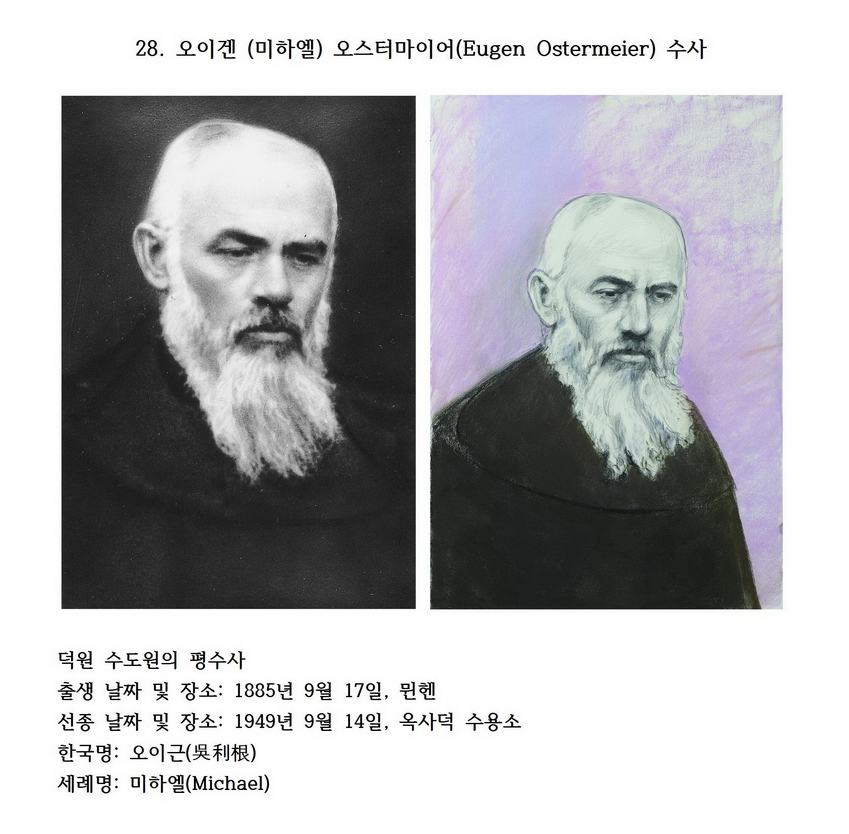
Brother Eugen (Michael) Ostermeier was born on September 17, 1885, in Munich (St. Ludwig / St. Ursula parish), the son of the farmer Josef Ostermeier and his wife Kreszentia. He attended the lower classes of the gymnasium at Donauwörth and Munich and after the fourth year went into commerce. He came of a deeply devout family and lived a life of strict moral discipline.
Toward the end of 1904 he entered the monastery as a lay brother candidate and received the name Eugen (Eugenius). At St. Ottilien he made his first profession on February 3, 1907, and his perpetual vows on February 3, 1910, and on September 12, 1912, he was sent to Seoul.
Brother Eugen had been trained at St. Ottilien as a gardener — a great help in cultivating the extensive vineyard in Seoul. At Tokwon too he kept a vineyard, so that during the Second World War, when the vines elsewhere had all been sawn down, every priest in Korea could still obtain wine for Mass.
Brother Eugen was imprisoned in Pyongyang, then transferred to the Oksadok camp, where, worn down by its cruelties, he died a martyr on September 14, 1949.
Testimony of Sister Diomedes Meffert, physician in the camp: “Brother Eugen Ostermeier had been sickly since the prison. He no longer had the strength for the camp’s unending labor. Yet, wishing to contribute to the community’s livelihood, he conceived the idea of panning for gold in the clear brook that ran by the camp (in many parts of Korea the sands carry gold). Since he was sixty-four, the police let him be. But while he was building his apparatus his intestinal illness rapidly worsened. For a long time it looked like dysentery; a pathological examination was impossible. Then, when his strength fell away sharply and his features grew visibly wasted, I began to suspect a tumor of the digestive tract, perhaps of the stomach, and later study confirmed me in that opinion. Brother Eugen was pure and devout, and offered his life willingly as a sacrifice. I still remember how he rejoiced when, on September 12, the sisters sang a hymn to Our Lady before the room where he lay dying. He died on the feast of the Exaltation of the Holy Cross, September 14, 1949.”
한국어 원문
미하엘(오이겐 수사) 오스터마이어는 1885년 9월 17일 뮌헨(성 루드비히/성 우르술라)에서 농부였던 아버지 요셉 오스터마이어와 어머니 크레스첸시아 사이에서 태어났다. 그는 도나우뵈르트와 뮌헨의 김나지움에서 저학년을 다녔고 4학년을 마치고는 상업에 종사하였다. 신심이 매우 깊은 가문 출신으로, 그는 도덕적으로 엄격한 삶을 살았다. 1904년 말경 그는 평수사 지망으로 수도원에 입회하였고 오이겐(에우제니우스 Eugenius)이라는 수도명을 받았다. 그는 상트 오틸리엔 수도원에서 1907년 2월 3일에 첫 서원을, 1910년 2월 3일에 종신서원을 하였고 1912년 9월 12일에 서울로 파견되었다.
오이겐 수사는 상트 오틸리엔 수도원에서 정원사로서 교육을 받았는데, 서울에서 매우 넓은 포도밭을 경작하는 데 큰 도움이 되었다. 덕원 수도원에서도 포도원을 경작함으로써 제2차 세계대전 중에 다른 곳의 포도나무들이 톱질로 모두 사라졌을 때, 한국의 모든 신부들이 미사에 쓸 포도주를 얻을 수 있었다.
오이겐 수사는 평양 인민감호소에 수감되었다가 옥사덕 강제 수용소로 이송되었고, 그곳 수용소의 학대에 시달리다가 1949년 9월 14일 순교하였다.
강제 수용소의 수녀 의사 디오메데스 메퍼트의 증언
오이겐 오스터마이어 수사는 감옥에 갇혀 있을 때부터 병약했다. 그는 수용소에서 계속되는 노동을 더 이상 계속할 힘이 없었다. 그러나 그는 우리 공동체의 생계에 보탬이 되고자 수용소 주위에 맑게 흐르는 실개천에서 금을 채취하려는 생각을 하게 되었다(한국의 많은 지역에는 금을 함유하고 있는 모래가 있었다). 그는 64세가 되었기 때문에 경찰은 그가 하는 대로 내버려 두었다. 그러나 기구를 만들려고 하는 동안에 그의 장 질환이 급속히 악화되었다. 오랫동안 그 상태는 이질처럼 보였다. 병리학적인 조사는 불가능했다. 그러고 나서 체력이 급격히 떨어지고 그의 모습이 눈에 띄게 초췌해졌을 때 나는 위암과 같은 소화기 종양이라는 것을 의심하게 되었고, 말년의 연구가 나의 그런 생각을 굳어지게 했다. 오이겐 수사는 순수하고 경건했으며 자신의 생명을 기꺼이 희생제물로 바쳤다. 9월 12일, 임종의 방 앞에서 수녀들이 “성모성가”를 불렀을 때 그가 얼마나 기뻐했는지 나는 아직도 기억하고 있다. 그는 “성 십자가 현양 축일”인 1949년 9월 14일에 사망했다.
Source: the “Martyrs of Tokwon” series published by Waegwan Abbey, reprinted and translated here with permission.
출처: 성 베네딕도회 왜관수도원 ‘덕원의 순교자’ 연재 · 왜관수도원의 허락을 받아 게재·번역합니다.
Leave a Reply