Martyrs of Tokwon · 7 / 38
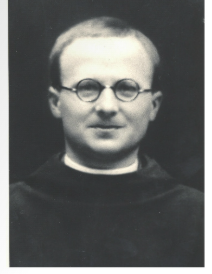
Fr. Dagobert Enk (嚴光豪, 1907–1950) was born on September 15, 1907, in the parish of St. Margaret in Munich, and was baptized Otto Friedrich. His father Eduard was a merchant; his mother was Maria Anna. He spent some childhood years at Ismaning, then from 1914 lived with his grandfather in Freiburg and went to school there, entering the Berthold gymnasium in 1917. In 1923 he followed his aunt to Munich and finished his secondary education at the Wittelsbacher gymnasium. At his parents’ wish he then went to his uncle August Wittmann at Oberhaunstadt near Ingolstadt — a farmer of standing who bore the government title of agricultural councillor — and served an apprenticeship in farming. A report of April 1, 1927, praises him warmly: “Young Enk carried out everything entrusted to him faithfully, handled every matter with care, and kept the accounts precisely and reliably.”
His religion teacher at the Wittelsbacher gymnasium spoke to the deeper things: “A member of the Freiburg students’ association, this student joined all the devotional exercises of the Neudeutschland youth movement here in Munich as well. Born of a deeply believing family, he showed the greatest interest and zeal in every practice of piety. For years he has spoken of a priestly and religious vocation and of the missions. Considering his spirit, his exemplary life, his obedience, his measured bearing, his kindness to others, his unselfishness, his ideal aspiration toward a vocation and his constancy, I judge him called to religious life and suited to the missions — provided his health proves equal to it.”
The teacher’s words were fulfilled when he entered St. Ottilien. In mid-May 1927 he received the name Dagobert and began his novitiate; he made his first profession on May 14, 1928, and his perpetual vows on May 17, 1931. On March 26, 1933, he was ordained a priest in the abbey church of St. Ottilien by Bishop Joseph Kumpfmüller of Augsburg. The next year, on April 2, 1934, he was sent to Tokwon Abbey — and so fulfilled all the boyhood dreams at once: monk, priest, and missionary.
Arriving at Tokwon in early October 1934, he gave himself first to the language while looking after the library and serving as master of ceremonies. Practically able in administration and finance, and mature in his humanity, he was named procurator and refectorian after the annual retreat in May 1935. Managing the monastery’s household, he had also to meet the many needs of the vicariate parishes staffed by Tokwon missionaries. In constant contact with Korean and Japanese businessmen and employees, he grew into the work quickly. He strove to fulfill his office faithfully and to meet every request of the brothers; when something could not be supplied, he always answered them with a kind word. As the procurator responsible for the community’s livelihood he governed himself with great strictness.
After the liberation, the communist party that seized power in the North regarded Tokwon Abbey as a thorn in its eye and ordered the political security bureau to close and confiscate it. They began on December 1, 1948, by arresting the procurator, Fr. Dagobert, on charges of illegal wine-making and tax evasion. But the wine they ‘discovered’ had been made that summer at the request of the agricultural cooperative, which had accepted all responsibility for it. Caught in the scenario the party had written, Fr. Dagobert was taken to Wonsan and held without trial. The monastery tried every means to free him, in vain. After Tokwon Abbey was closed on May 9, 1949, he was moved with the other brothers to the Pyongyang prison, and was finally sentenced to five years for illicit brewing. He remained imprisoned in Pyongyang with the seven other convicted brothers, while the rest left for the Oksadok camp on August 5, 1949. He was still in the prison after the war broke out, and on October 3, 1950, as the ROK army neared Pyongyang, he was shot by the retreating North Korean forces.
한국어 원문
엄광호 다고베르트 신부
엄광호 다고베르트(Dagobert Enk, 嚴光豪, 1907-1950) 신부는 뮌헨München 교구 성 마르가레트St. Margareth본당 출신으로 1907년 9월 15일에 태어나 오토 프리드릭Otto Friedrich이라는 이름으로 세례를 받았다. 아버지 이름은 에두아르드Eduard이고 어머니 이름은 마리아 안나Maria Anna였는데, 아버지는 상업에 종사하였다. 어린 시절 그는 몇 해 동안 이스마닝Ismaning에서 자라다가 1914년부터는 프라이부륵Freiburg으로 가서 할아버지 댁에 살며 학교를 다녔다. 1917년부터 그는 프라이부륵의 베르톨트Berthold 김나지움에서 공부하다가 1923년에 뮌헨으로 이사한 이모를 따라가서 비텔스바허Wittelsbacher 김나지움에서 중등교육을 마쳤다. 그 후 그는 부모들이 바라는대로 잉골슈타트Ingolstadt 인근에 있는 오버하운슈타트Oberhaunstadt에 있던 외숙부에게 갔다. 그의 외숙부인 아우구스트 비트만August Wittmann은 농장을 운영하고 있었고, 정부에서 농업자문관 (Ladesökonomierat) 칭호를 받은 지역유지였다. 외숙부 밑에서 그는 농업기술을 배우는 견습생으로 지냈는데, 1927년 4월 1일에 작성된 보고문에는 그에 대한 평판이 매우 좋게 적혀 있다. “엔크군은 자신에게 맡겨진 모든 일을 성실하게 해냈으며, 매사를 꼼꼼하게 처리했으며, 특히 장부정리를 빈틈없고 믿음직스럽게 해냈다.”
비텔스바허 김나지움의 종교담당 교사는 그의 내면적 삶과 관련하여 더 중요한 부분들을 알려 주었다. “프라이부륵 학생연합회 회원으로 활동했던 이 학생은 뮌헨에 와서도 신독일 청년회(Übungen von Neudeutschland)의 모든 신심활동에 참여했다. 신앙이 매우 깊은 집안에서 태어난 그는 모든 신심활동에 대하여 지대한 관심과 열의를 보였다. 여러 해 동안 그는 사제성소, 수도성소와 선교활동에 대하여 말해왔다.그의 정신, 모범적인 생활, 순종적인 자세, 절도 있는 태도, 다른 이들에게 베푸는 친절, 이기적이지 않은 처신, 성소에 대한 이상적인 지향, 초지일관하는 모습을 감안해 볼 때, 나는 그가 수도성소에 불리었고 선교활동에도 적합하다고 여겨지는데, 다만 그 생활을 감당할 만큼 건강이 요구된다.”
종교담당 교사가 한 이 말은 그가 상트 오틸리엔 수도원에 입회하면서 그대로 이루어졌다. 1927년 5월 중순 그는 다고베르트라는 수도명을 받고 수련기를 시작하였다. 1928년 5월 14일 그는 첫서원을 발했고, 1931년 5월 17일에 종신서원을 했다. 1933년 3월 26일 그는 상트 오틸리엔 수도원 성당에서 아욱스부륵Augsburg 교구장 요세프 쿰프뮐러(Josepf Kumpfmüller, 1869-1949)주교에 의하여 사제로 서품되었다. 그 이듬해인 1934년 4월 2일 그는 덕원 수도원으로 선교 파견되면서, 수도자, 사제 그리고 선교사가 되고 싶었던 소년시절의 꿈을 모두 이루었다.
1934년 10월 초순. 덕원 수도원에 도착한 그는 우선 말공부에 전념하면서 도서관 정리와 예절지기를 맡아보았다. 관리와 경리 분야에서 실무 능력을 갖추었고, 또한 성숙한 인간미를 겸비한 그는 1935년 5월 연례피정이 끝난 후 당가와 식당 책임자로 임명되었다. 그는 수도원 살림을 꾸려가면서 덕원 수도원 소속 선교사들이 파견되어 있는 원산 대목구 내 본당의 갖가지 요구들도 채워 주어야 했다. 그는 조선인과 일본인 사업가들 및 고용인들을 수시로 접촉해 가며 비교적 빠르게 업무에 적응해갔다. 그는 맡은 직무를 성실히 수행하려고 노력했고, 수도형제의 모든 요구를 들어주고자 했다. 만일 필요한 것이 준비되지 못하면 그는 항상 따뜻한 말로 그들에게 응했다. 수도원 살림을 책임진 당가로서 그는 아주 엄격하게 스스로를 통제하였다.
8.15 광복 후 북한에서 정권을 잡은 공산당은 덕원 수도원을 눈엣가시처럼 여겨 정치 보위부에 수도원을 폐쇄하고 몰수하라는 지시를 내렸다. 그들은 우선 1948년 12월 1일 수도원 당가인 다고베르트 신부를 포도주 불법 제조 및 탈세 혐의로 체포하였다. 그러나 그들이 적발한 포도주는 그해 여름 농업조합에서 수도원 측에 요청하여 담가놓았으며, 이는 조합 측에서 모든 책임을 지기로 한 일이었다. 공산당이 짜 놓은 각본에 걸려든 다고베르트 신부는 원산으로 압송되었고, 미결상태로 구류를 살았다. 수도원에서는 그를 석방시키려고 백방으로 손을 썼지만, 모두 허사로 돌아갔다. 결국 그는 1949년 5월 9일 덕원 수도원이 폐쇄된 후 다른 수도형제들과 함께 평양 인민교화소로 이송되었다. 결국 그는 밀주제조 혐의로 징역 5년을 선고받았다.그는 유죄판결을 받은 다른 7명의 수도형제들과 함께 평양 인민교화소로 수감되었다. 반면에 그밖의 수도형제들은 1949년 8월 5일 옥사덕 수용소로 떠났다. 그 이듬해 6.25 전쟁이 발발한 후에도 그는 교화소에 수감 중이었으나 국군이 평양을 탈환할 무렵, 퇴각을 서두르는 인민군에 의해 1950년 10월 3일 총살당했다.
자료출처 한국가톨릭대사전(한국 교회사 연구소), Necrologium(왜관 수도원), Todesanzeige(상트 오틸리엔 수도원)
분도 2009년 봄호 20-21 페이지
Source: the “Martyrs of Tokwon” series published by Waegwan Abbey, reprinted and translated here with permission.
출처: 성 베네딕도회 왜관수도원 ‘덕원의 순교자’ 연재 · 왜관수도원의 허락을 받아 게재·번역합니다.
Leave a Reply