Martyrs of Tokwon · 33 / 38
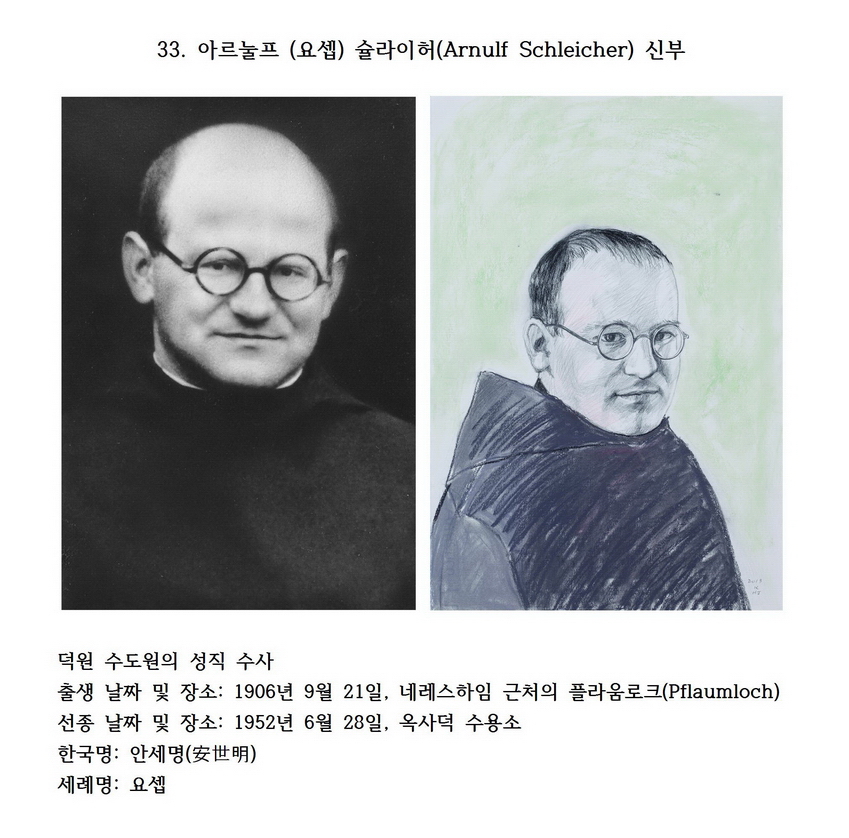
Fr. Arnulf (Josef) Schleicher was born in 1906 at Pflaumloch in the Diocese of Rottenburg-Stuttgart, to Karl Schleicher and Theresia Gips. He completed his classical studies at Rottenburg, passed the regional examination in his fifth year, and moved to the boarding school at Ehingen, where he finished the gymnasium.
He began his novitiate on May 10, 1925, with the religious name Arnulf, made his first profession on May 15, 1926, and his perpetual vows on August 2, 1929. He studied philosophy at St. Ottilien and theology at Sant’Anselmo in Rome, and was ordained a priest on July 13, 1930, in the chapel of the Dillingen seminary by Auxiliary Bishop Karl Reth.
Sent to Tokwon Abbey on April 10, 1932, Fr. Arnulf served as professor of dogmatic theology and scriptural exegesis at the seminary, as novice master, and as subprior.
Imprisoned with the other German brothers, he gave conferences on Holy Scripture for them throughout the captivity and devoted himself to them as their superior. Fr. Arnulf Schleicher died in the Oksadok camp on June 28, 1952 — the last of the martyrs under the communists.
Testimony of Sister Diomedes Meffert, physician in the camp: “Fr. Arnulf Schleicher, who had worked at the Tokwon seminary, gave inspired lectures, courses, and retreats, and was ready to help in any situation where he was needed. He was a man wholly of the mind, with little gift for practical labor. As subprior of Tokwon he had been named spiritual head of the camp community by Bishop Sauer on leaving the Pyongyang prison. Straightforward as he was, he found it impossible to hide his inner revulsion at the monstrous injustice done to our monastery — and that earned him the authorities’ hatred. He became the target of the guards’ constant fault-finding and malicious scheming, and this tormented him more than hunger or overwork. Through the winter of 1951–52 he still worked with the charcoal burners and the woodcutters, but as the sowing season began his condition worsened and hard labor became impossible. His kidneys and heart were failing, a purulent bronchitis had long plagued him, and the swelling of his body took on an alarming character. It was clear to all that death was near. Inwardly he was still full of plans — better mission methods, the founding of new parishes, the rebuilding of the Tokwon abbey and seminary he so loved. In the night of June 28 he collapsed unconscious, and about nine in the morning he passed away.”
한국어 원문
요셉(아르눌프 신부) 슐라이허는 1906년 로텐부르그-슈투트가르트 교구 플라움로크에서 아버지 칼 슐라이허와 어머니 테레사 깁스 사이에서 태어났다. 요셉은 로텐부르그에서 인문계 공부를 마치고 5학년 때 지역 시험에 통과한 후 에힝엔 기숙학교(Konvikt Ehingen)로 옮겨 그곳에서 김나지움을 졸업했다. 요셉은 1925년 5월 10일 아르눌프(아르눌푸스 Arnulfus)라는 수도명을 받고 수련기를 시작했고 1926년 5월 15일 첫서원을, 1929년 8월 2일 종신서원을 하였다. 이후 상트 오틸리엔에서 철학을 공부하고 로마의 성 안셀모 대학에서 신학공부를 하였다. 그리고 1930년 7월 13일 딜링엔 신학교의 경당에서 칼 레트 보좌주교로부터 사제품을 받았다.
1932년 4월 10일 덕원 수도원으로 파견된 아르눌프 신부는 덕원 신학교에서 교의신학과 성서주석학 교수, 수련장 그리고 부원장 소임을 하였다.
아르눌프 신부 역시 다른 독일 형제들과 함께 수감되었는데 수감생활 동안 그는 수도형제들을 위해 성서주석학 강화(講話)를 하였으며, 장상으로서 그들을 위해 헌신하였다. 아르눌프 슐라이허 신부는 1952년 6월 28일 북한 옥사덕 강제 수용소에서 숨을 거두었다. 그는 공산주의에 의한 마지막 순교자였다.
강제 수용소의 수녀 의사 디오메데스 메퍼트의 증언
덕원 신학교에서 일했던 아르눌프 슐라이허 신부는 영감 있는 강의와 강습회, 피정을 지도했고 그를 필요로 하는 상황이라면 어떤 경우에라도 돕고자 했다. 그는 명백한 정신노동자였으며 실제적인 생활노동에는 재능이 거의 없었다. 덕원 수도원의 부원장으로서 그는 평양 감옥을 떠날 때 사우어 주교에 의해 수용소 공동체의 영적 책임자로 지명되었다. 직선적인 심성으로 인해 그에게는 우리 수도원이 당해야 했던 엄청난 부정에 대한 내적인 반감을 숨기는 것이 불가능했다. 그것이 당국의 미움을 사게 만들었다. 그래서 그는 감시인들의 계속적인 비판과 악의에 찬 계략의 대상이 되었다. 이러한 상황은 굶주림과 과로보다 그를 더 고통스럽게 만들었다. 1951년과 1952년 사이의 겨울까지만 해도 그는 숯 굽는 일이나 나무 베는 사람들과 함께 일했으나, 파종기가 시작되면서 병세가 악화되어 힘든 육체노동을 할 수 없게 되었다. 신장과 심장이 더 이상 기능을 하지 않았고 화농성 기관지염이 그를 오랫동안 괴롭혔으며, 몸의 종창이 심각한 양상을 띠기 시작했다. 사람들은 그에게 죽음이 임박했다는 것을 알았다. 그는 내적으로는 항상 선교 방법의 개선과 새로운 본당 설립의 가능성, 그리고 그가 그렇게 좋아했던 덕원 수도원과 신학교의 재건을 생각했다. 하지만 그는 6월 28일 밤에 의식을 잃고 쓰러졌고 아침 9시경 세상을 떠났다.
Source: the “Martyrs of Tokwon” series published by Waegwan Abbey, reprinted and translated here with permission.
출처: 성 베네딕도회 왜관수도원 ‘덕원의 순교자’ 연재 · 왜관수도원의 허락을 받아 게재·번역합니다.
Leave a Reply